
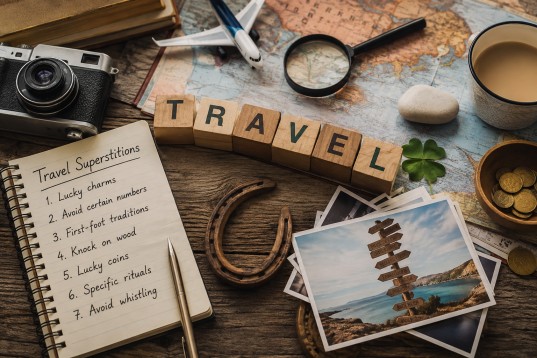
Across the globe, travelers often rely on age-old traditions and superstitions to ensure a safe and fortunate journey. These customs, steeped in folklore, are passed down through generations, offering both comfort and a sense of protection. Despite their mythical origins, many of these practices hold a special place in the hearts of travelers, who continue to embrace them before embarking on their voyages.
In the Balkans, travelers often carry a clove of garlic, tucked away in their luggage, as a talisman against bad luck and negative energy. This simple act is believed to pave the way for a smooth journey. Meanwhile, air travelers around the world commonly touch the exterior of their aircraft before boarding. This gesture serves as a symbolic expression of trust and gratitude, while also helping to alleviate anxiety about flying.
Another widespread belief holds that beginning a journey with the right foot brings good fortune. As a result, many travelers consciously step onto planes with their right foot first, hoping to set a positive tone for the trip ahead. Similarly, in Eastern Europe and the Middle East, it is customary for family members to pour water behind a departing traveler, symbolizing a smooth and safe return home.
Cultural aversions to certain numbers also permeate travel practices. For instance, the number 13 is often avoided in Western countries, while the number 4 is shunned in East Asia due to its phonetic similarity to the word for death. In Italy, the number 17 carries similar superstitions. Consequently, many hotels, buildings, and airlines opt to exclude these numbers from their room or seat numbering systems.
In several Slavic cultures, travelers are encouraged to sit on their packed luggage for a brief moment before leaving. This pause allows them to relax, collect their thoughts, and ensure nothing has been forgotten. Additionally, sweeping the floor immediately after a traveler’s departure is avoided in various cultures, as it is thought to bring misfortune or hinder their safe return. Though these practices lack scientific backing, they remain an intriguing aspect of global travel culture, symbolizing humanity’s enduring quest for reassurance on the road.